
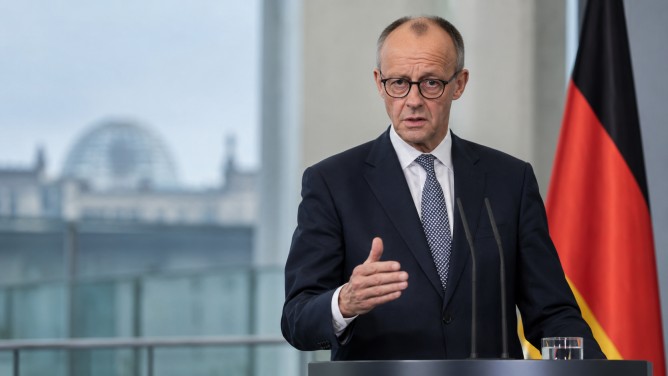
The recent regional elections in Germany have reshaped the political landscape, amplifying divisions and sparking significant consequences for Chancellor Friedrich Merz’s Christian Democratic Union (CDU). With the Alternative for Germany (AfD) gaining traction, particularly in eastern regions, the results have intensified scrutiny on the CDU’s leadership and its future direction.
In Berlin, the left-wing Die Linke emerged victorious, securing approximately 25.7% of the vote and surpassing the CDU, which garnered 18.8%. The AfD made a substantial impact, finishing in third place with 16.3%. Meanwhile, in Mecklenburg-Western Pomerania, the AfD achieved a major triumph, capturing about 38.2% of the vote and edging out the Social Democrats, who obtained 35.5%. The CDU faced a particularly stark defeat in this region, falling below the 5% threshold required for representation in the state parliament with only 4.9% of the vote.
These developments highlight a growing regional disparity in Germany’s political landscape. The AfD’s electoral success, especially in the eastern states, underscores its strengthening base, while Die Linke’s performance in Berlin signals a shift in urban political dynamics. For the CDU, these results have prompted a reevaluation of its strategies and leadership under Chancellor Merz, who remains committed to his government’s economic and social reform agenda despite the setbacks.
The pressure on Merz is further compounded by the AfD’s strong showing in the earlier Saxony-Anhalt elections, raising questions about his leadership’s ability to counter the rise of right-wing populism. The CDU’s future direction is now a subject of intense debate, as the party navigates a challenging political environment with competing priorities and regional variances.
As Germany grapples with these electoral outcomes, the implications for national politics are profound. The AfD’s gains and the CDU’s struggles reflect a nation at a political crossroads, with potential ramifications for policy-making and governance as parties reassess their positions in response to shifting voter allegiances.