
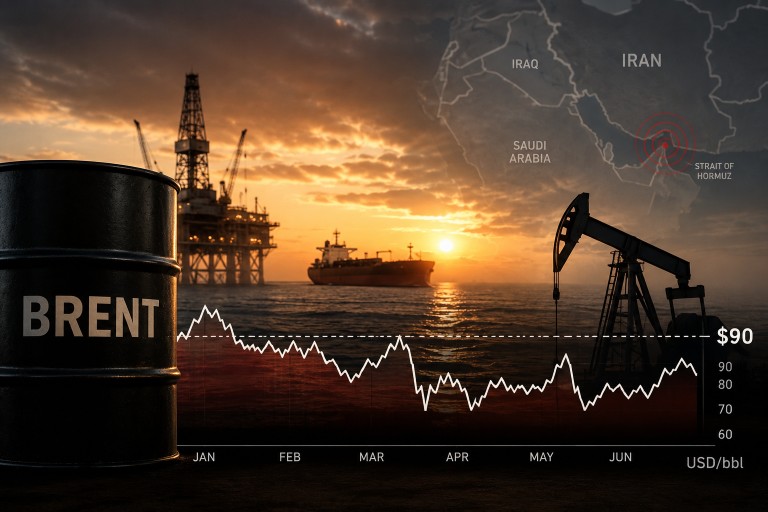
Brent crude oil prices might need a more sustained disruption in the Strait of Hormuz or clearer indicators of tightening global supplies to surpass the $90 per barrel mark, despite achieving their largest weekly gain since April. On Friday, the global oil benchmark hovered around $85, marking an 11% weekly rise, while the U.S. benchmark, West Texas Intermediate, neared $80. This surge in oil prices follows renewed military tensions between the United States and Iran, which have disrupted Middle Eastern supply routes and decreased tanker traffic through the Strait of Hormuz, a critical passageway for about 20% of the world’s oil flow.
Despite these developments, Brent crude has found it challenging to exceed this week’s peak of $87.55 per barrel. This struggle persists even as conflicts in the region escalate and tanker movements through Hormuz significantly slow. Analysts suggest that the market’s belief in the possibility of diplomatic negotiations is tempering further price increases. Traders are paying close attention to global inventory levels to determine if a sharp decline indicates a shortage and if the disruption in Hormuz becomes more enduring.
Indeed, the oil markets have shown resilience amid escalating military exchanges. Brent crude prices have remained within a narrow band recently, indicating that investors anticipate tensions might de-escalate rather than intensify. The Strait of Hormuz continues to be a focal point for energy markets. As tanker traffic reduces, exporters are increasingly seeking alternative routes to mitigate their reliance on this strategic waterway.
The ripple effects are impacting more than just crude oil. In the U.S., refining margins have increased due to tightening diesel and gasoline supplies, while European fuel markets are also experiencing strain. Adding to the pressure on global energy supplies are reduced fuel exports from Russia. Market players are now concentrating on two critical developments: whether oil inventories will drop significantly enough to suggest a supply shortage and if diplomatic efforts will fail, leading to a prolonged disruption in the Gulf region.
Until one of these scenarios unfolds, experts believe Brent crude prices are likely to stay below the $90-per-barrel threshold, despite the heightened geopolitical risks. The situation remains fluid, with the market closely monitoring both inventory levels and diplomatic developments as potential catalysts for future price movements.