
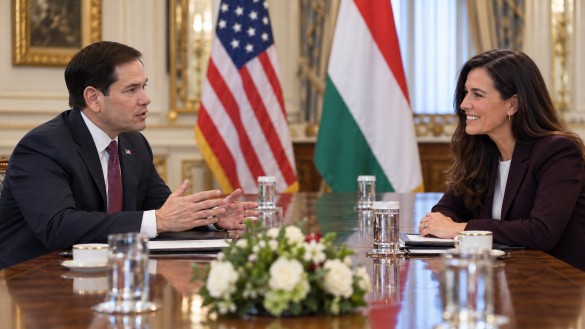
In a bid to bolster energy cooperation and enhance security measures, Hungary and the United States signed significant agreements during a meeting between Hungarian Foreign Minister Anita Orbán and U.S. Secretary of State Marco Rubio in Washington on Thursday. The agreements aim to improve regional energy infrastructure and strengthen law enforcement collaboration between the two nations.
The discussions, delayed from an earlier schedule due to Rubio accompanying President Trump on a campaign tour, focused on vital issues such as natural gas supplies, nuclear cooperation, and intelligence sharing. The first agreement, established under the U.S.-backed Trump Peace Pipelines Framework, seeks to expand American liquefied natural gas (LNG) exports and develop energy infrastructure across Central and Eastern Europe and the Western Balkans.
This initiative underscores a continuation of Hungary’s energy policy, with several elements tracing back to former Prime Minister Viktor Orbán’s administration. Notably, a civilian nuclear cooperation agreement was signed between Hungary and the U.S. in February 2026, and Hungary’s current TISZA government has pushed for its parliamentary approval to make it legally binding.
The second agreement between the two countries focuses on enhancing cooperation in law enforcement, particularly in intelligence sharing and combating crimes associated with extremist organizations. Minister Orbán emphasized the importance of collaboration against far-left extremist groups, including networks linked to Antifa Ost. This issue is particularly sensitive in Hungary following the 2023 attacks in Budapest tied to such extremist elements.
The meeting and subsequent agreements highlight an ongoing effort to deepen collaboration between Hungary and the United States in critical areas of energy security and law enforcement. These steps reflect a continuity of policies initiated under Hungary’s previous government and mark a significant stride in U.S.-Hungary relations.